
MEDIA CONTACT: J.A. Lyon, Director of Marketing & Communications, jlyon@monticello.org
FOR IMMEDIATE RELEASE – December 3, 2024
CHARLOTTESVILLE, VA – The National Science Foundation, the independent federal agency that supports scientific discovery across all 50 states and US territories, and The Conservation Fund, a nonprofit organization with the mission of promoting environmental conservation, have awarded a combined total of $354,000 to Monticello’s Digital Archaeological Archive of Comparative Slavery (DAACS) (http://www.daacs.org/). The grants fund new research to advance our understanding of the lives of ordinary people in Colonial Virginia and the Carolinas who made and used pottery vessels known as colonoware.
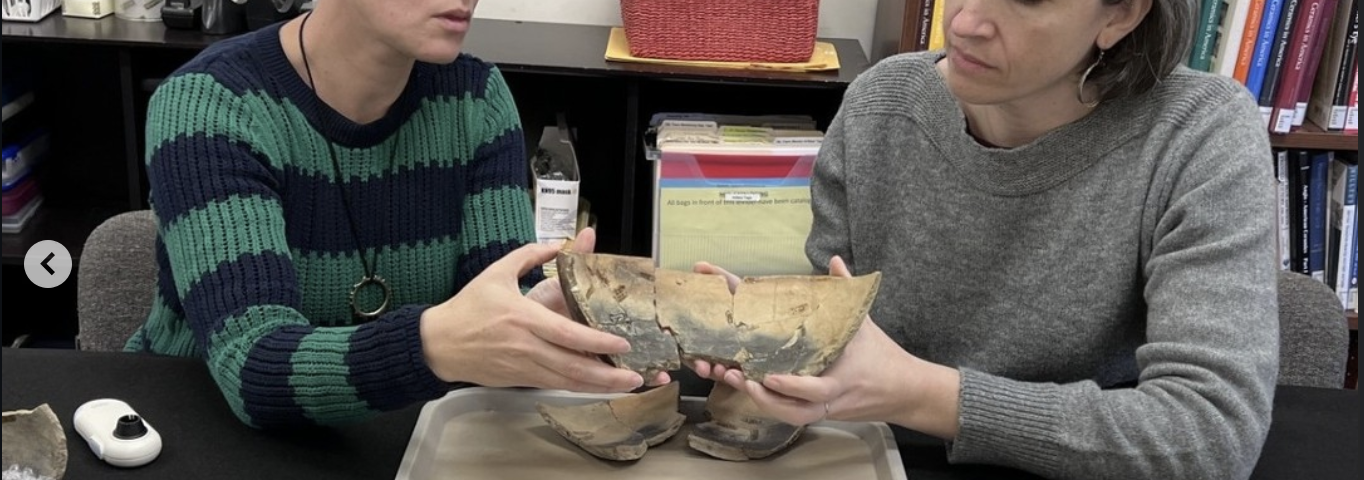
Colonoware is a type of handmade, low-fired pottery with roots in Indigenous North American and African traditions. Tiny details in these vessels, invisible to the naked eye, are now accessible using new scientific methods. They hold clues about the traditions that informed the manufacture of individual excavated pots, where they were made, and the goals of their makers, such as whether they made pots for household use or for sale on markets. “This will be the largest study of colonoware ever conducted, spanning Virginia and North and South Carolina, allowing us to understand how potters and pottery consumers responded to very different colonial economies,” noted Elizabeth Bollwerk, Project Manager for DAACS and principal investigator for both grants. To achieve geographical scale required, DAACS is collaborating with colleagues from the University of North Carolina, the South Carolina Department of Natural Resources, and the University of Missouri.
“We are excited to finally answer some basic, long-standing colonoware puzzles, with technology that is now available,” said Lindsay Bloch, Senior Archaeological Analyst and co-principal investigator of the grants. “Colonoware was rarely mentioned in historical accounts, so looking at the artifacts themselves are the best way to understand this phenomenon.” Using existing archaeological collections from the tri-state region, researchers will analyze hundreds of thousands of colonoware fragments and other artifacts. The team will apply advanced techniques to identify where vessels were produced, how people learned to make them, and how they were used in daily life. These two grants offer a valuable opportunity to build on earlier work conducted by DAACS on the archaeology of colonial societies whose economies were based on slavery. Throughout their research, the project team will collaborate with Indigenous and Black descendant communities to incorporate their feedback into the methods used to gather, analyze, interpret, and share the data generated from this project. Resulting data will be made available on the DAACS website, in accordance with these community collaborators.
“The support from NSF, The Conservation Fund, will enable us to advance our mission of fostering new kinds of collaboration, data sharing, and comparative analysis,” said Jillian Galle, DAACS Project Director.