
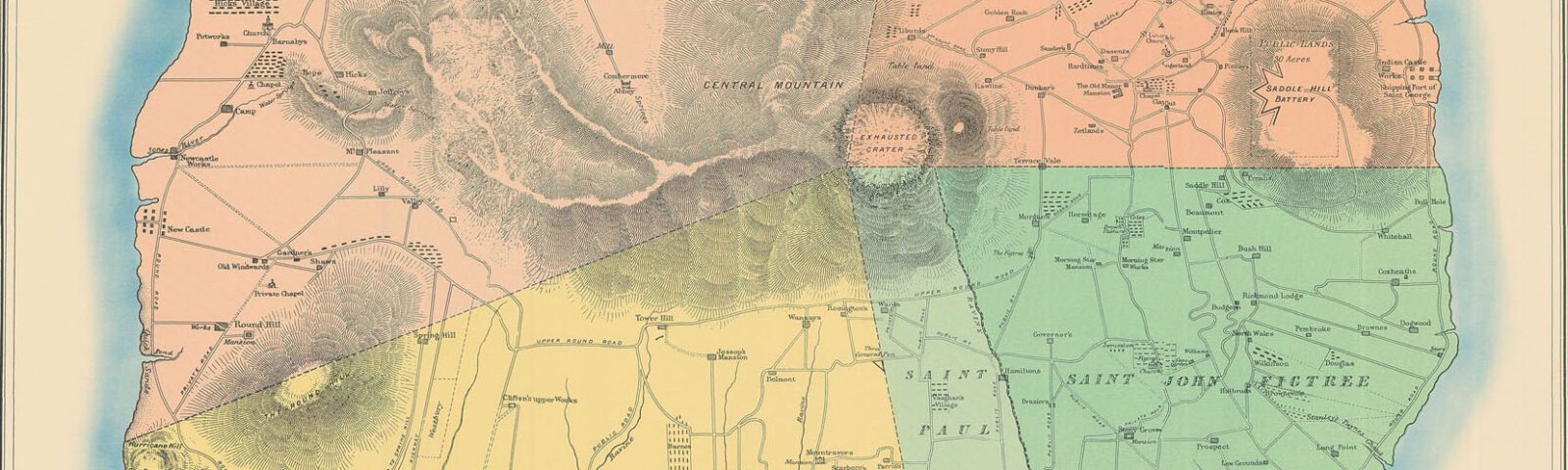
We are pleased to announce that artifactual, contextual, and spatial data from the Jessups and New River Estates on Nevis and The Spring Estate on St. Kitts are now available through DAACS. Data were generated from shovel-test-pit surveys of the Jessups I and Jessups II villages and New River I and New River II villages on Nevis. The results of preliminary shovel-test-pit excavations from the village at The Spring Estate on St. Kitts are also available. To access background, chronology, and image information from these sites, begin browsing at https://new.daacs.org/archaeological-sites/ (opens in a new tab). To begin querying the data, start with the DAACS query pages: https://new.daacs.org/query-the-database/ (opens in a new tab).
The archaeological surveys of the villages at The Jessups Estate, The New River Estate, and The Spring were conducted as part of the St. Kitts-Nevis Digital Archaeology Initiative (SKNDAI). Initial fieldwork began in 2006 and was expanded in 2008. The 2008 archaeological and archival research, and the subsequent web site development, was made possible by through a Transatlantic Digitization Grant sponsored by the National Endowment for the Humanities (opens in a new tab) (US) and the Higher Education Funding Council for England of the United Kingdom acting through the Joint Information Systems Committee. (opens in a new tab)
The St. Kitts-Nevis Digital Archaeology Initiative (SKNDAI) is a collaborative project designed to further scholarship on slavery through the development of an integrated digital archive of diverse archaeological and historical data related to the experiences of the enslaved men and women who labored on 17th-, 18th- and 19th-century sugar plantations in the Caribbean. An international team of scholars from The Digital Archaeological Archive of Comparative Slavery at the Thomas Jefferson Foundation in Charlottesville, Virginia (http://new.daacs.org (opens in a new tab)), the University of Southampton’s Nevis Heritage Project (http://www.arch.soton.ac.uk/Research/Nevis/Nevis.html (opens in a new tab)), and the International Slavery Museum in Liverpool (http://www.liverpoolmuseums.org.uk/ism/ (opens in a new tab)) have worked together to digitize and deliver on the web information from five 18th-century plantations and their slave villages located on Nevis and St. Kitts. The result will be a first-of-its-kind digital collection of fully searchable archaeological and historical data from multiple slave village sites in the Caribbean.